IFEM Emergency Department Quality Certification Frequently Asked Questions (FAQs)
1. ABOUT THE IFEM CERTIFICATION PROGRAMME
The IFEM Emergency Department Quality Certification Programme is a voluntary international certification programme that is an evidence-based framework for evaluating ED performance against internationally benchmarked standards covering quality, safety, governance, clinical processes, and operational effectiveness. Organizations that successfully meet the certification requirements receive international recognition for their commitment to delivering high-quality emergency care and continuous improvement. IFEM has authorized TASNEEF as the exclusive audit partner to conduct certification audits on behalf of IFEM.
IFEM ED Certification benefits an organization in the following ways:
- International Recognition and Enhanced Reputation for Emergency Care Services through Certification.
- Drives Stronger ED Governance
- Promotes Continuous Quality Enhancement and Standardization of Care Delivery.
- Provides a Competitive Advantage and Differentiates the Organization in the Healthcare Market.
- Improved Clinical Processes and Patient Outcomes
- Better Patient Flow and Efficiency
- Data-Driven Quality Improvement and Decision-Making
- Enhanced Staff Education and Alignment with International Best Practices
Any Emergency Department, whether standalone or part of a hospital (private or public), that has at least one year of operational performance data and meets the eligibility requirements (core criteria) can apply for certification.
- Bronze Level: Represents foundational quality and safety
- Silver Level: Indicates intermediate level of system maturity
- Gold Level: Denotes advanced system maturity, high performance and reliability in emergency care delivery.
Yes. Each Emergency Department location must submit a separate application and is assessed independently.
2. STANDARDS
There are 3 parts in the standard:
- Part – A: provides a guidance on how to read and interpret the standards
- Part – B: presents the technical requirements of the Standard as Chapters. Each chapter has criteria and specifications listed as requirements.
- Part – C: provides the details of Certification process, Scoring methodology and certification rules.
Core Criteria are mandatory requirements representing essential elements of safe and effective emergency care. One can apply for IFEM ED certification only if the requirements of core criteria are met. Non-compliance with any Core Criteria will result in denial of certification.
Yes. The IFEM Emergency Department Quality Certification Standards and Certification Rules are available for download via https://www.ifem.cc/certification.
3. APPLICATION
Organizations can get started by following these steps:
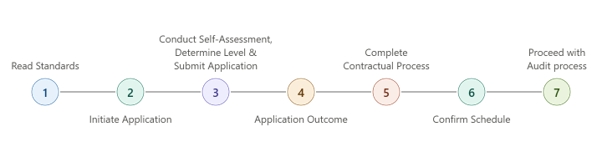
Conduct Self-assessment and apply as per the level of conformance to the standard requirements (Bronze/Silver/Gold).
No. The facility is assessed and certified strictly against the level it applies for.
Yes. An organization may apply for a higher certification level after one year of receiving certification. The upgrade process requires a new application and full reassessment.
4. CERTIFICATION FEES AND COSTS
Certification fee is based on the level of application (Bronze/Silver/Gold) and the geographical location as per World Bank classification. The tariff list of certification fee applicable for each country is available on our website.
The applicant organization is fully responsible for arranging for the auditors’ travel, accommodation, and related logistical expenses as defined in the certification contract.
5. PREPARATION FOR CERTIFICATION
Organizations should first familiarize themselves with;
- IFEM Emergency Department Quality Certification Standards (Part A & B)
- Certification Rules. (Part C)
Preparation should include identifying the stakeholders, conducting an internal review of existing processes, conducting a self-assessment, identifying any gaps, implementing necessary improvements, and ensuring that supporting documentation and evidence are readily available for submission.
Yes. Following receipt of the application, an Eligibility Verification Tool, Self-Assessment Toolkit, and guidance to the certification process will be provided. A Certification Coordinator is assigned to support the organization throughout the administrative and audit planning stages.
6. CERTIFICATION PROCESS
The certification process includes:
- Application and eligibility verification
- Stage I: Desktop (document) audit
- Stage II: On-site audit
- Audit report and scoring
- Certification decision
- Non-conformance closure (if any)
The complete process typically takes approximately 3-4 months from the self-assessment submission, provided there are no delays in schedule confirmations, and closure of any non-conformities.
Stage I is a desktop review of documentation and evidence submitted with the self-assessment checklist to assess preparedness and identify focus areas for the on-site audit.
Stage II is an on-site assessment where auditors verify the implementation and effectiveness of the Emergency Department standards. The audit uses multiple assessment methods like Document and record reviews, Staff interviews, Facility walkthroughs, Observation of clinical and operational processes and Verification of records and supporting evidence.
On-site stage II audits are conducted in person. However, in exceptional circumstances such as force majeure events, IFEM may approve a remote audit format.
The duration depends on the certification level applied for and the size and complexity of the Emergency Department. Typically, the on-site audit is completed within 2–3 days.
The audit is conducted by qualified team from TASNEEF. Typical composition includes:
- One emergency physician or senior clinical assessor
- One Quality healthcare auditor
- Additional auditor may join as an observer.
7. AUDIT FINDINGS, NON-CONFORMITIES & CERTIFICATION DECISION
Each specification of the standard criteria is assessed as either Conformity as “Met” or Non-Conformity as “Not Met.”
Certain criteria specifications may be considered as Not Applicable if they are exclusion to scope of ED services. All the Not Applicable must be justified and approved by IFEM, to be excluded from scoring.
To achieve certification, an organization must meet all the three listed below:
- Meet all Core Criteria specifications
- Achieve at least 85% in each chapter
- Achieve at least 90% overall score
The hospital will receive an NC report if the non-conformities result in not meeting the certification criteria. The hospital ED is required to implement necessary corrective actions for the identified NCs, and closure evidence shall be submitted within 30 calendar days of receiving the NC report.
The decision is typically issued within 30 calendar days after completion of any NC closure evidence review.
If certification is denied, the organization may reapply after a minimum of six months, following adequate preparation and improvement actions.
Yes. Organizations may submit an appeal within 14 calendar days of receiving the certification decision with necessary evidence to support the appeal. Scope of review is strictly limited to the documentation already presented during the certification process.
8. CERTIFICATION VALIDITY AND MAINTENANCE
Certification is valid for three years from the date of the certification decision. Certified EDs must continue to comply with all applicable standards, maintain regulatory compliance.
Recertification is a full reassessment conducted at the end of the three-year cycle to confirm continued compliance and improvement.
9. CERTIFICATION SEAL
Yes. Certified EDs receive a certification seal corresponding to their awarded level (Bronze/Silver/Gold).
No. The seal applies only to the certified Emergency Department and must not imply hospital-wide certification. Rules for use of the certification mark/seal will be shared, and the organization shall strictly comply with the rules to use the seal.
10. GENERAL QUESTIONS
Yes. IFEM and its certification partners maintain strict confidentiality throughout the certification process. All the documentation or data obtained during the audit are treated as strictly confidential and are used solely for the intended purpose of the certification process.
Organizations may contact the IFEM certification team through the official certification email “edcertification@ifem.cc“, “edcertification@tasneef.ae“ provided on the IFEM website.